
micro1 Cortex
The visibility layer for agentic AI
Making agent reliability legible
As AI agents move into real workflows, teams are missing the basics: clear ways to measure performance, visibility into where and why agents fail, and monitoring once agents are live. Cortex is micro1’s visibility and improvement layer for agentic AI, combining expert human judgment with evaluations drawn from real workflows. The UX challenge was turning a technical, multi-step process into something a team can read at a glance.
A dashboard built around the evaluation loop
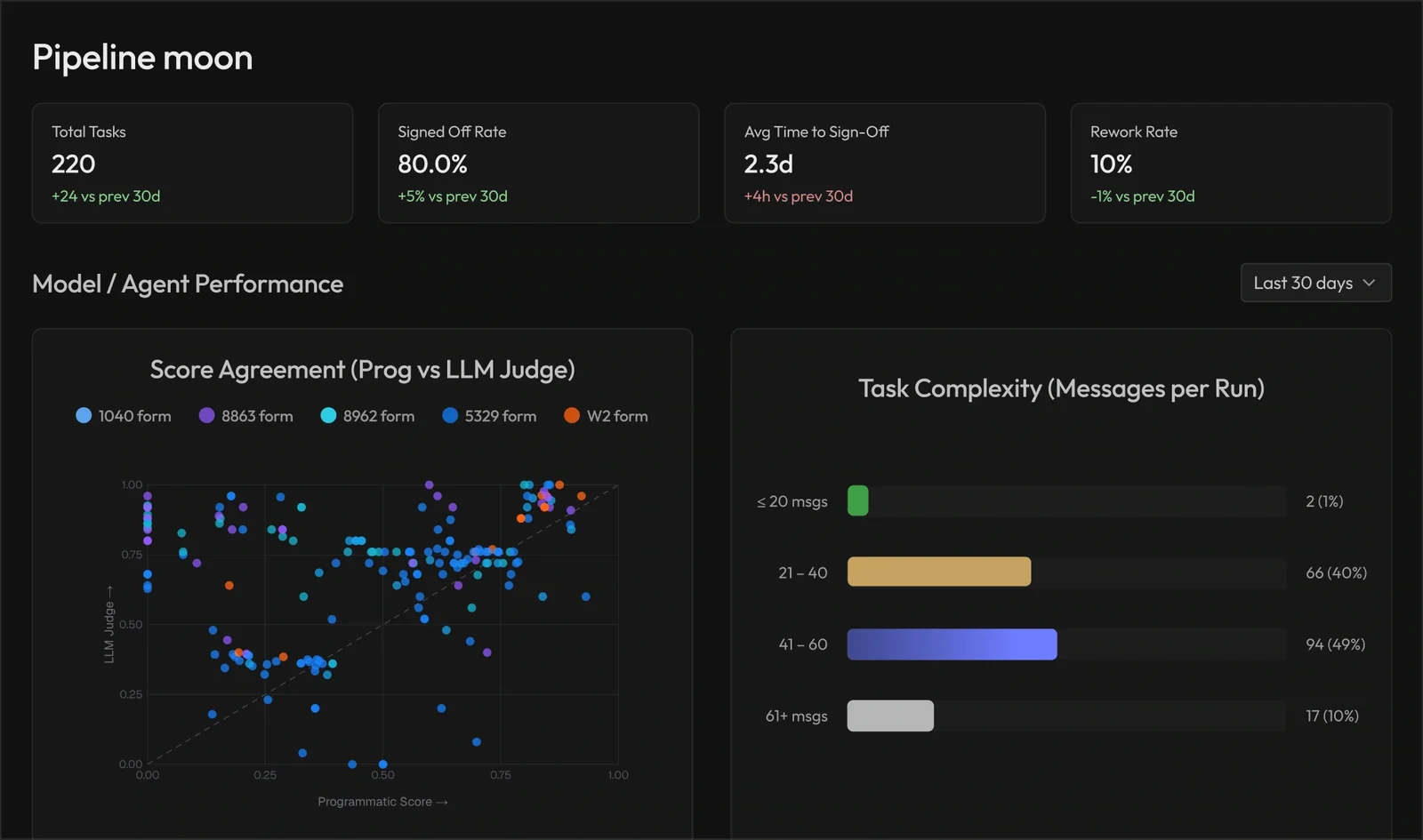
Cortex follows a loop: design the evaluation, diagnose failures, produce expert training data, then keep monitoring reliability. The pipeline view mirrors that loop. Four headline numbers sit at the top (total tasks, signed-off rate, average time to sign-off and rework rate), each with its change against the previous 30 days and a green or red cue for direction, so a reviewer knows within seconds whether things are improving. A date-range control keeps the comparison in the user’s hands.
Showing where automated and human judgment disagree
Below the headline numbers, the performance views explain the why. A score-agreement chart plots programmatic scores against an LLM judge, colour-coded by form type, with a diagonal reference line so disagreements stand out immediately. A task-complexity chart groups runs by message count with clear proportions. The interface stays quiet and dark, colour is reserved for data, and every card carries a plain-language title.
How AI was used
AI is part of the product itself: Cortex pairs programmatic scoring and LLM judges with expert human review, so a lot of the UX work was deciding how to show where they agree and where they don’t. In my own process, AI helped me draft microcopy and prototype dashboard states faster, while the information design was decided by hand.